1990s · East (USSR/CIS) · 1995
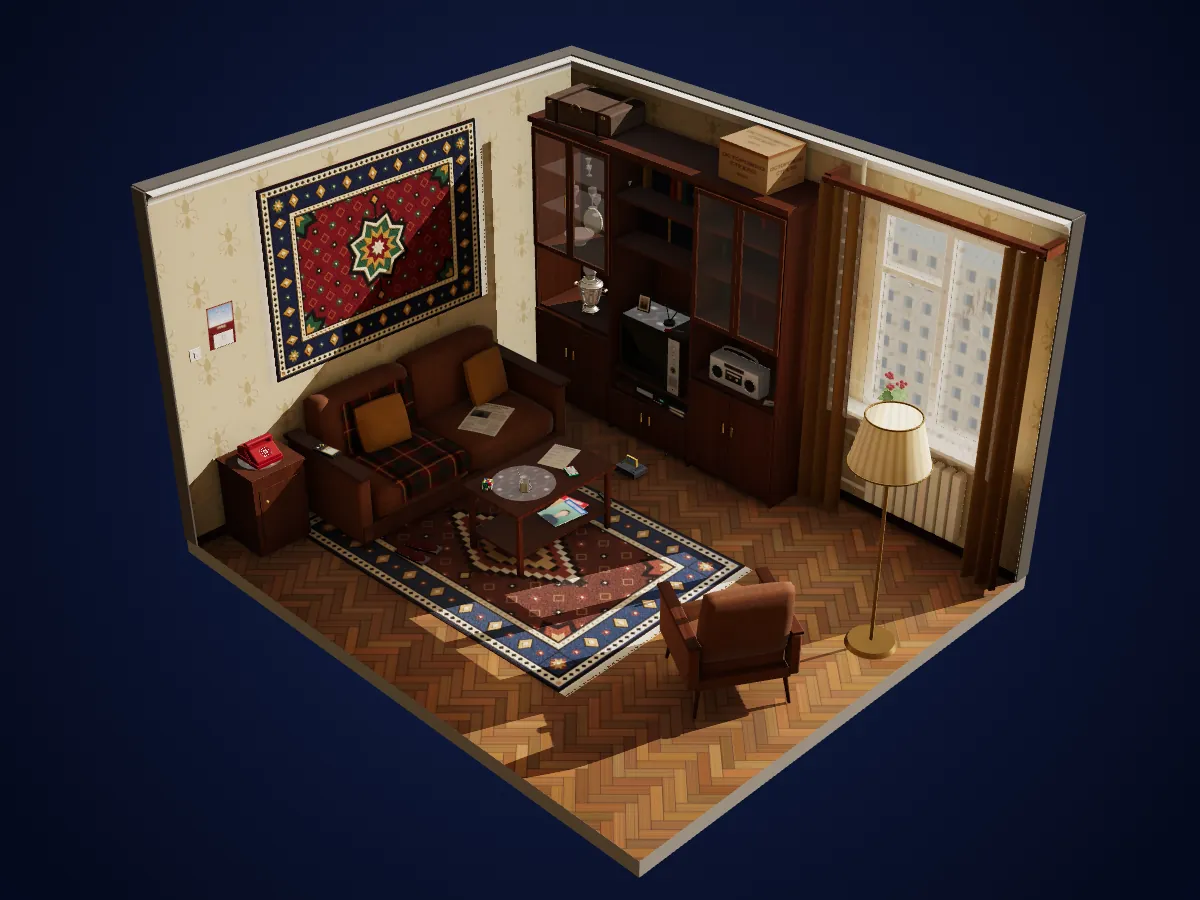
Panel-block living room, 1995
A two-room flat on the fifth floor of a nine-storey panel block, somewhere between Kyiv, Minsk and Moscow. It is 1995: the country on the passport has changed and prices change every week, but the room looks much as it did in 1985, with a few new arrivals from the market. Look around, and tap anything that catches your eye.
In the roomFound 0 of 14
Secrets 0 of 4
Read every story
- Wall unit
- The pride of the flat. A polished wall unit took up a whole wall and held everything a family owned that was worth showing: the crystal, the good dinner service, the books, and a niche for the television. People queued, signed up on lists and paid in instalments to get one, and once it was in, the room was arranged around it for the next twenty years. The crystal behind the glass came out on New Year's Eve and for birthdays; the rest of the year it was only dusted.
- Television
- A Soviet colour set that took a minute to warm up and a firm slap on the side when the picture rolled. The "horns" on top were the room aerial, and finding the angle that cleared the snow on the second channel was a family skill. By the mid-nineties it showed Latin American soap operas, game shows and the evening news, and the whole flat planned its evening around them.
- Dendy console
- Not a Nintendo, officially, but everyone knew. The Dendy was a Famicom clone sold across the former Soviet Union from 1992, with a baby elephant for a mascot and a TV show of its own. It plugged into the aerial socket of the family television, so a game meant negotiating with whoever wanted the news. Cartridges promised "400 in 1" and held about a dozen games, repeated.
- Carpet on the wall
- Every visitor from abroad asks about it. The carpet on the wall kept the cold off a thin panel wall, muffled the neighbours, and showed that the family had managed to get hold of a good one. Children fell asleep tracing its patterns, and many people can still draw theirs from memory.
- Sofa bed
- By day a sofa, by night the parents' bed. In a two-room flat the living room was a bedroom too, so the "book" sofa unfolded every evening with a clunk the whole stairwell knew, and folded back up before breakfast. The tartan throw hid the worn patches.
- Rotary phone
- A home line was something families waited years for, so the phone was treated with respect and lived on a little stand of its own. Dialling 100 got you the speaking clock, which is how everyone set their watches. Long calls were frowned on: someone might be trying to get through.
- Tear-off calendar
- Every morning somebody tore off yesterday. The pad hung by the phone, a page for every day of the year: the date, sunrise and sunset, and an anniversary, a recipe or a piece of advice, all printed a year ahead. The torn-off pages were read on the back, then used for shopping lists.
- Floor lamp
- The evening light. The ceiling light was for guests and for cleaning; the rest of the time the room was lit by the floor lamp by the window, and the circle under its fabric shade was the cosiest place in the flat to read.
- Window and tulle
- Lace tulle on a wire, heavy curtains at the sides, a geranium on the sill, and underneath a cast-iron radiator that could not be turned down, so all winter the little top pane, the fortochka, stayed open. Across the yard, an identical nine-storey block looked back.
- Brick Game
- Left on the arm of the sofa, as always. The handheld everyone called "Tetris", whatever was printed on it, bought at a market stall and passed between brother and sister until the batteries died in the middle of a record.
- Nu, Pogodi!
- On the coffee table, next to the TV guide. The Elektronika game with the wolf catching eggs was the most wanted present of the late eighties, and by the nineties it had become the thing a parent picked up "just to see" and could not put down.
- Rubik's Cube
- Scrambled, of course. Nobody in the flat could solve it, though an uncle claimed he once had, and somebody had peeled off a sticker and put it back in the wrong place.
- Radio-cassette player
- The radio-cassette player on the wall unit did everything: the radio in the morning, copied tapes in the evening, and songs recorded off the air with a finger hovering over Pause. The good TDK tape was for music; everything else went on whatever was cheapest.
- Electric samovar
- A wedding present from the eighties, polished before guests came and carried to the big family table on holidays. On a Sunday it was switched on right where it stood, hissed for a few minutes and then rumbled, and the tea was poured into glasses in metal holders, as on a train. On weekdays it was the kettle on the stove, and the samovar stood in the wall unit looking important.
- Black-and-white television (1985)
- A heavy Soviet black-and-white set in a wooden case. A colour one cost several months' wages, so this one stayed. There were only a couple of channels, and the big selector clunked between them. The valves took a while to warm up, the picture grew slowly out of the grey, and at nine o'clock the whole block was watching the same news.
- Computer in the corner (2005)
- The newest member of the family: a beige tower, a monitor nearly as deep as it is wide, and a corner desk bought specially, because nothing else would fit. It was officially for the children's studies. In practice there was a queue for it: homework, Counter-Strike, and, once the phone line was free after eleven, the internet, by the hour, through a modem everyone in the flat could hear.
- Nokia 3310 (2005)
- Left on the coffee table where Nu, Pogodi! used to lie. A mobile had stopped being something for businessmen with gold chains and become something a parent carried, on a prepaid card, counting the minutes. Texts were cheaper than calls, so a whole family learned to write them with nine keys. The battery lasted a week, and the landline by the sofa started to ring less often.
- DVD player (2005)
- It took over the video recorder's shelf, for a price that would have been unthinkable a few years before. It played anything, which mattered, because the discs came from a market stall: nine films on one disc, a single voice reading every part, and a box promising something quite different from what was inside. The video tapes were put away, "just in case".
Remember a room that belongs here? Suggest a room